


Dental Insurance Plan
Value, Standard, Royal and the new 100/70/50 Benefit Plans—Over 400 Covered Procedures
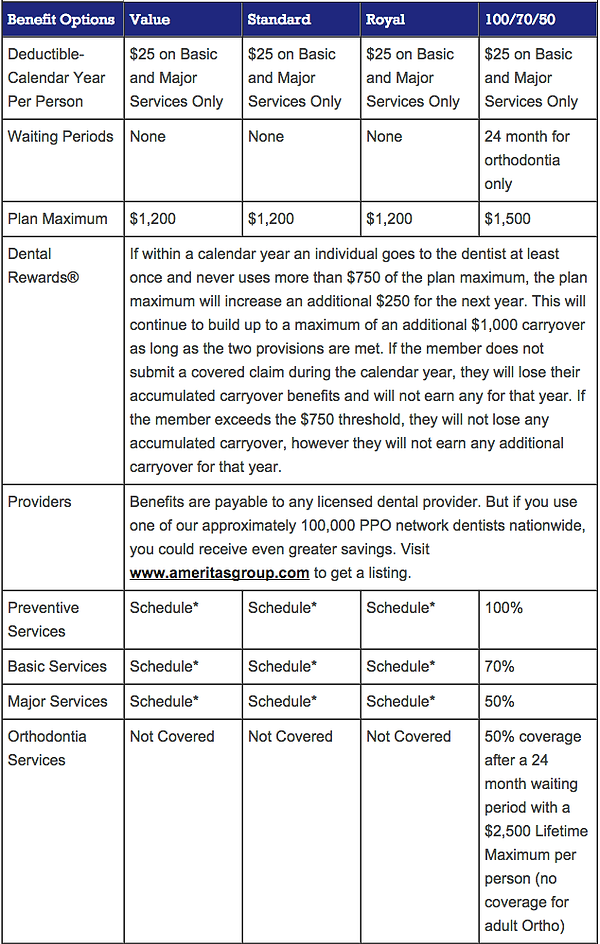
Deductible
$25 per calendar year per person deductible for basic and major services ONLY!
Elimination Period
No waiting period on any preventative, basic or major service.
Plan Maximum
$1,200 per calendar year per person for the Value, Standard and Royal Plans. $1,500 for the 100/70/50 plan. (This is a combined maximum for dental and vision benefits)
Dental Rewards
If within a calendar year an individual goes to the dentist at least once and never uses more than $750 of the plan maximum, the plan maximum will increase an additional $250 for the next year. This will continue to build up to a maximum of an additional $1,000 carry over as long as the two provisions are met. If the member does not submit a covered claim during the calendar year, they will lose their accumulated carryover benefits and will not earn any for that year. If the member exceeds the $750 threshold, they will not lose any accumulated carryover, however they will not earn any additional carryover for that year.


How Much Will the Insurance Pay?
Make sure you add up the benefits for each procedure performed to get the total benefit amount for one dental visit!

For More Information on Benefits Call 877-817-4801
Covered Expenses will not include and no benefit will be payable for expenses incurred:
-
for any procedure except exams, cleaning and fluoride applications for the first 12 months when an insured or dependent becomes classified as a late entrant. If an insured or dependent does not enroll within 31 days from the date the person qualifies for the insurance or who elected to become insured again after canceling a premium contribution agreement will be classified as a late entrant.
-
for any treatment which is for cosmetic purposes. Facings on crowns or pontics behind the second bicuspid are considered cosmetic.
-
to replace any prosthetic appliance, crown, inlay or onlay restoration, or fixed partial denture within five years of the date of the last placement of these items. However, if a replacement is required because on an accidental bodily injury sustained while the person is insured, it will be a Covered Expense.
-
for initial placement of any prosthetic appliance of fixed partial denture unless such placement is needed because of the extraction of one or more natural teeth while a person is insured. The extraction of a third molar (wisdom tooth) will not qualify. Any such appliance or fixed partial denture must include the replacement of the extracted tooth or teeth.
-
for any procedure started before a person becomes insured.
-
for any procedure which began after a person’s insurance terminates; or for any prosthetic dental appliances installed or delivered more than 90 days after a person’s insurance terminates.
-
to replace lost or stolen appliances.
-
for appliances, restorations, or procedures to:
alter vertical dimension;
restore or maintain occlusion;
splint or replace tooth structure lost because of abrasion or attrition; or
treat disturbances of the temporomandibular joint (T.M.J.). (except in the states of Alabama, Florida, Minnesota, Mississippi, and Washington)
-
for any procedure which is not shown on the List of Dental Procedures provided with your Certificate of Insurance.
-
for education or training in, and supplies used for, dietary or nutritional counseling, personal oral hygiene or dental plaque control.
-
for the completion of claim forms.
-
for orthodontic treatment.
-
because of any injury arising out of, or in the course of, work for wage or profit.
-
by a person because of a sickness for which he or she is eligible for benefits under any Worker’s Compensation act or similar law.
-
for charges for which a person is not liable or which would not have been made had no insurance been in force.
-
for services which are not recommended by a physician or which are not required for necessary care and treatment.
-
because of war or any act of war, declared or not.
-
by a person if payment is not legal where the person is living when expenses are incurred.
-
for sealants which are:
not applied to a permanent molar,
applied after attaining age 17,
reapplied to a molar within 3-years from the date of a previous sealant application.
-
subgingival curettage or root planning (procedure numbers 4220 and 4341) unless the presence of periodontal disease is confirmed by both radiographs and pocket depth summaries of each tooth involved.
*Please refer to policy certificate for complete details on all benefits, frequencies and plan limitations.